
Introduction
For decades, software has followed a familiar model.
If you wanted to send an email, you opened an email application. If you wanted to create a presentation, you launched presentation software. If you needed to book a flight, you opened a travel website or app. If you wanted to analyze business data, you navigated through dashboards, filters, reports, and spreadsheets.
In 2026, that model is beginning to change.
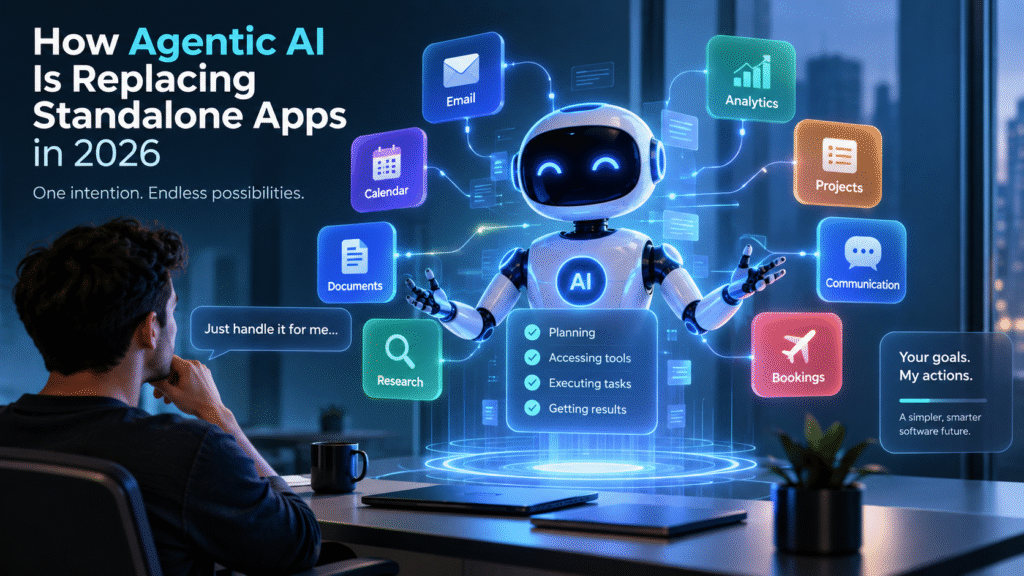
Instead of asking people to open multiple applications and manually complete individual steps, agentic AI systems can increasingly understand a user’s goal, access the required tools, make decisions, and execute multi-step workflows on the user’s behalf.
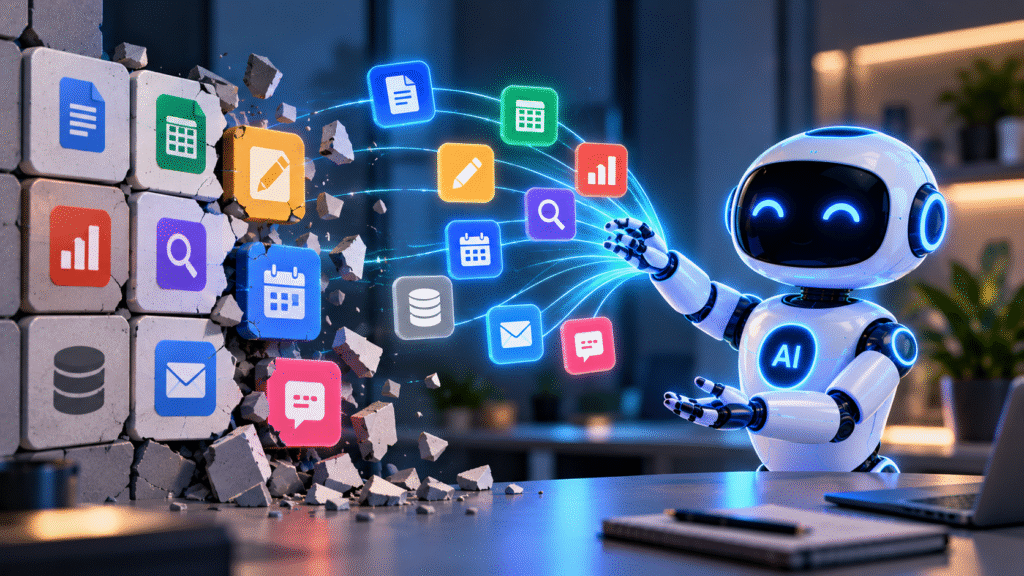
However, the direction is becoming increasingly clear: the application may no longer be the primary interface between people and software. The AI agent could become that interface.
So, what does this mean for the future of apps, SaaS companies, developers, businesses, and everyday users?
Let’s explore.
What Is Agentic AI?
Agentic AI refers to artificial intelligence systems that can do more than simply generate responses.
A conventional chatbot generally waits for a prompt and produces an answer. An AI assistant may help a person complete a task. An AI agent, by contrast, can potentially interpret a goal, plan a sequence of actions, use tools, access information, execute operations, evaluate results, and continue working until the objective is completed.
For example, imagine telling an AI:
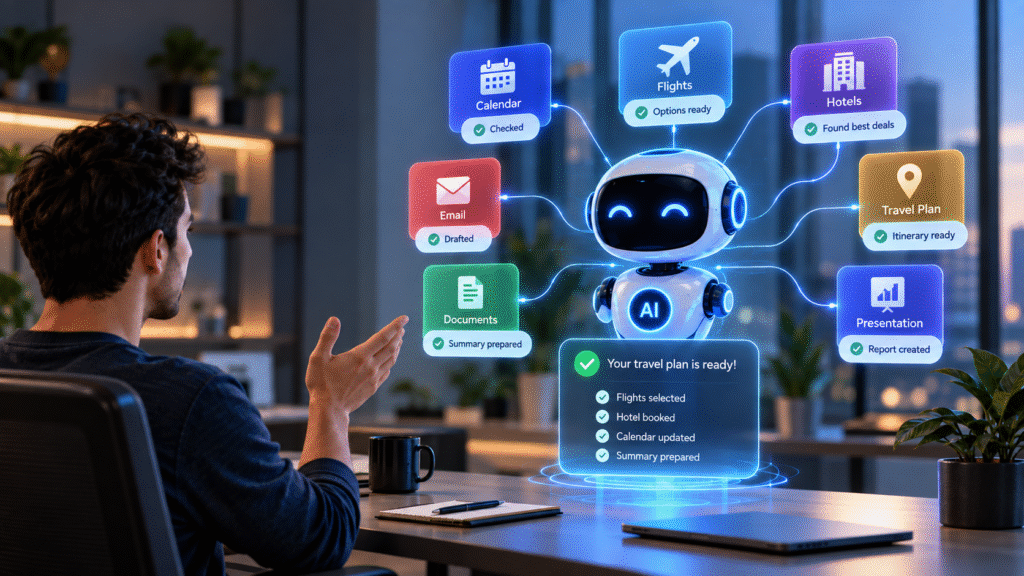
“Find the best flight for my schedule, check my calendar, compare the available options, and prepare the booking for my approval.”
A traditional application requires the user to:
- Open a calendar.
- Check availability.
- Open a browser.
- Search flights.
- Compare prices.
- Select a flight.
- Enter information.
- Complete the booking.
An agentic system aims to coordinate many of these steps through one conversational request.
The important change is therefore not simply AI versus apps.
It is:
Apps as destinations → AI agents as orchestrators.
Microsoft describes this emerging model as moving from application-centered interaction toward intent-based interaction. In this model, users express what they want to accomplish while agents determine which systems, data, permissions, and workflows are required.
Why Standalone Apps Are Being Challenged
Standalone applications were originally designed around human interaction.
Users had to learn:
- Where features were located
- Which menus to open
- Which buttons to click
- Which forms to complete
- How different applications worked
- How to transfer information between systems
This created an enormous software ecosystem.
There are separate applications for:
- Calendar
- CRM
- Accounting
- Project management
- Customer support
- Communication
- Marketing
- Analytics
- File storage
- Human resources
- Procurement
- Sales
- Design
- Research
Each application solves a specific problem.
From App-Centric Software to Intent-Centric Software
The traditional software model looks something like this:
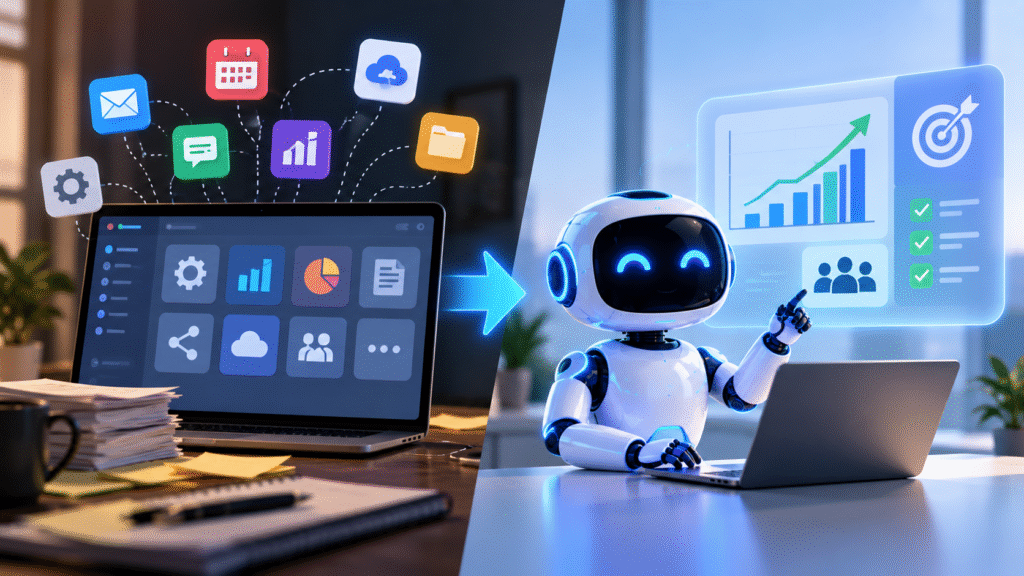
User → App → Feature → Action → Result
The emerging agentic model looks more like:
User → Intent → AI Agent → Tools + Data + Apps → Result
This is a fundamental change.
Instead of asking:
“Which application should I use?”
the user asks:
“What do I want to accomplish?”
The AI handles more of the operational complexity.
For example:
| Traditional Approach | Agentic AI Approach |
|---|---|
| Open CRM | Tell agent to review customer pipeline |
| Search customer records | Agent retrieves relevant records |
| Open email application | Agent accesses authorized email tools |
| Write follow-up email | Agent drafts message |
| Open calendar | Agent checks availability |
| Update CRM | Agent records the activity |
| Create report | Agent summarizes results |
| Manually coordinate everything | Agent orchestrates workflow |
Agentic AI vs Traditional Apps
Understanding the difference between conventional software and agentic systems is essential.
| Feature | Traditional App | Agentic AI |
|---|---|---|
| Primary interface | Screens and menus | Natural language or intent |
| User role | Performs actions | Defines goals |
| Workflow | Mostly predefined | Can be dynamically planned |
| Data access | Usually application-specific | Can potentially span multiple systems |
| Automation | Rule-based | Reasoning + tools + automation |
| Cross-app workflows | Often manual | Can be orchestrated |
| Decision-making | Mostly human | Shared between human and agent |
| Personalization | Limited/configured | Context-aware |
| Execution | User-driven | Agent-driven or supervised |
| Main value | Features | Outcomes |
How AI Agents Can Replace Multiple Apps
The most important reason agentic AI could replace certain standalone applications is workflow consolidation.
Consider a marketing manager preparing a campaign.
Today, the process might involve:
- Keyword research software
- Analytics platforms
- Spreadsheet software
- Writing tools
- Image-generation tools
- Project-management software
- Email marketing software
- Social media platforms
An agentic workflow could potentially coordinate these activities through one central interface.
The user might request:
“Prepare a campaign for our new product. Analyze last month’s performance, identify promising keywords, create a content plan, draft the campaign assets, and prepare everything for approval.”
The agent could then:
- Retrieve historical performance data.
- Analyze relevant metrics.
- Research keywords.
- Identify opportunities.
- Generate a campaign structure.
- Draft content.
- Organize the deliverables.
- Create a project task list.
- Prepare an approval summary.
Human oversight can remain at important decision points.
This is the key difference between simple automation and agentic AI.
The system is not merely executing one predefined command. It is coordinating a broader objective.
The Rise of the AI-Native Interface
One of the biggest changes in 2026 is the emergence of the AI-native interface.
For decades, software companies competed on:
- Better dashboards
- Better navigation
- More features
- Faster interfaces
- More integrations
- More customizable menus
AI agents change the importance of these factors.
If a user can simply say:
“Show me the customers whose renewal risk increased this month and prepare follow-up plans.”
the user may not need to understand the underlying dashboard.
SaaS Is Entering a Major Transformation
Software-as-a-Service, or SaaS, has traditionally depended heavily on users logging into applications.
Companies often monetize SaaS through:
- Per-user subscriptions
- Monthly plans
- Feature tiers
- Seat licenses
- Usage limits
- Enterprise contracts
Agentic AI challenges this model.
If one AI agent can interact with several applications, organizations may eventually need fewer human seats across certain categories of software.
Gartner estimates that up to $234 billion of enterprise application software spending could be exposed to agentic arbitrage between now and 2030, potentially representing around 20% of enterprise SaaS spending by then.
The concept is straightforward:
If an AI agent can perform the work, the human may not need to interact directly with every application.
That creates pressure on SaaS businesses to rethink how they create and capture value.
The Shift From Features to Outcomes
Traditional SaaS marketing often emphasizes features.
For example:
- 100+ integrations
- Advanced dashboards
- Custom reports
- Workflow automation
- Collaboration features
Agentic software changes the conversation.
Instead of asking:
“What features does this application provide?”
customers may ask:
“What outcome can this AI system deliver?”
For example:
Traditional:
“Our CRM provides advanced customer analytics.”
Agentic:
“Our AI agent identifies high-risk customers and prepares retention actions.”
What Happens to Existing Apps?
The most likely future is not that every application disappears.
Instead, applications may evolve into backend capabilities for AI agents.
Think of an application as a collection of:
- Data
- APIs
- Business rules
- Permissions
- Workflows
- Specialized functionality
The AI agent becomes the layer that coordinates these capabilities.
For example:
Before:
User → CRM interface → CRM workflow
After:
User → AI Agent → CRM APIs/data/workflows
The CRM remains important.
But the user may interact with it less directly.
Microsoft describes this evolution by saying applications can become trusted capabilities that agents invoke rather than destinations that users must manually navigate.
Which Types of Apps Are Most Vulnerable?
Not every software category is equally exposed.
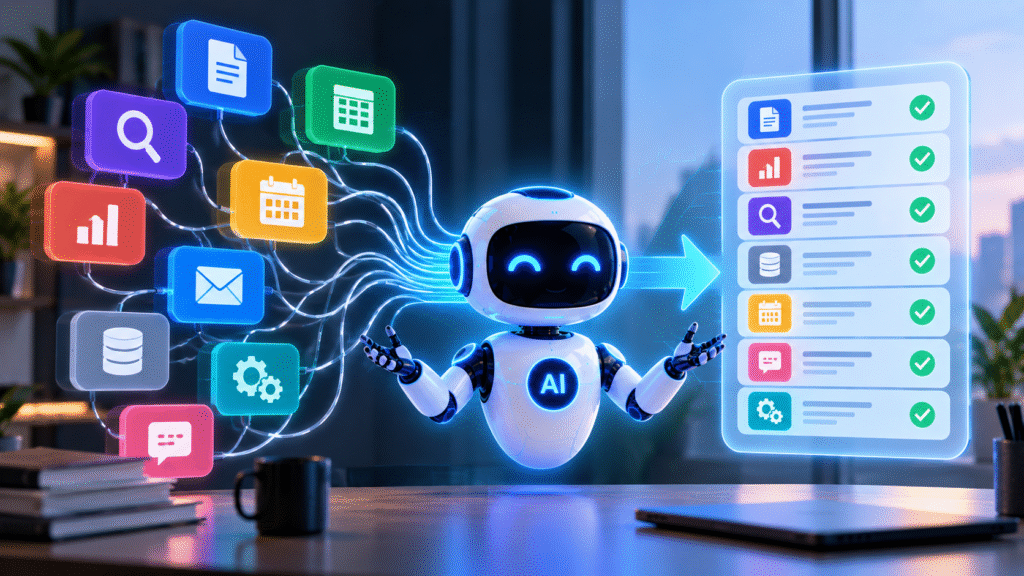
The applications most likely to face disruption are those that perform relatively standardized, repetitive, knowledge-based tasks.
Examples include:
1. Basic Productivity Tools
Simple note-taking, summarization, formatting, and document-generation tools could increasingly become AI-agent capabilities.
2. Reporting Tools
Agents can collect information from multiple sources and produce reports without requiring users to manually navigate dashboards.
3. Simple Research Tools
Instead of opening several websites and research platforms, users can ask an agent to gather and synthesize information.
4. Basic Data-Entry Software
Agents can potentially move information between systems automatically.
5. Scheduling Applications
AI assistants can understand calendars, availability, preferences, and constraints.
6. Simple Customer Support Tools
Agents can classify issues, retrieve information, draft responses, and execute approved workflows.
7. Routine Business Automation Platforms
Some repetitive workflows could be handled directly by agents rather than manually configured through separate automation interfaces.
Which Apps Are Less Likely to Disappear?
Some software categories are much harder to replace.
These include systems that provide:
- Highly specialized functionality
- Complex databases
- Regulatory compliance
- Security controls
- Financial records
- Enterprise identity management
- High-performance computing
- Specialized engineering tools
- Professional creative environments
- Mission-critical infrastructure
Therefore, the future is more nuanced than:
“AI will kill every app.”
A better prediction is:
“AI will change how people interact with many apps.”
AI Agents Are Becoming the New Orchestration Layer
The most important role of agentic AI may be orchestration.
Imagine an organization using:
- CRM
- ERP
- HR software
- Accounting software
- Project-management tools
- Communication platforms
- Data warehouses
- Customer support software
Traditionally, employees move between these systems.
An agent can potentially become the coordination layer between them.
For example:
User request:
“Prepare the monthly sales review.”
The agent could:
- Retrieve sales data.
- Compare it with previous periods.
- Identify significant changes.
- Review customer activity.
- Analyze pipeline movement.
- Prepare charts.
- Summarize important risks.
- Create a presentation.
- Request human approval.
- Distribute the approved report.
The Rise of Multi-Agent Systems
A single AI agent can be useful, but complex workflows may require multiple specialized agents.
For example, a business could have:
- Research Agent
- Finance Agent
- Marketing Agent
- Sales Agent
- Customer Support Agent
- Compliance Agent
- Data Analysis Agent
These agents can potentially collaborate.
Gartner expects collaborative AI agents to become increasingly important, with one-third of agentic AI implementations potentially combining agents with different skills by 2027.
Agentic AI in E-Commerce
E-commerce provides a particularly interesting example.
Traditional online shopping requires customers to:
- Search for products.
- Open product pages.
- Compare prices.
- Read reviews.
- Check specifications.
- Select a product.
- Add it to the cart.
- Complete checkout.
An AI shopping agent could potentially perform much of this research based on a user’s requirements.
For example:
“Find me a laptop suitable for schoolwork, video editing, and programming within my budget.”
The agent could compare specifications, availability, compatibility, and user preferences before presenting recommendations.
This is also changing how retailers think about digital commerce.
Shopify, for example, has been investing in AI and what it calls “agentic commerce,” with AI-driven traffic to Shopify stores reportedly increasing significantly in 2026.
The implication is significant:
The future customer may not browse every online store manually. An AI agent may do the discovery first.
Agentic AI in Business Productivity
Business productivity may be one of the biggest areas affected by agentic AI.
Imagine an employee starting the day by saying:
“Review everything important from yesterday and tell me what requires my attention.”
Instead of opening:
- Calendar
- Project management
- CRM
- Internal documents
- Team communication
the employee receives a prioritized summary.
The agent can potentially identify:
- Important messages
- Upcoming meetings
- Overdue tasks
- Customer issues
- Project risks
- Important approvals
- New opportunities
What This Means for Software Developers
The rise of agentic AI does not mean developers become unnecessary.
It changes what developers build.
Developers increasingly need to think about:
APIs
Can AI agents reliably interact with your software?
Permissions
What actions can an agent perform?
Context
What information does the agent need?
Structured Data
Can your system expose information in machine-readable formats?
Tool Calling
Can an AI invoke specific functions safely?
Authentication
Can you verify which agent and user initiated an action?
Observability
Can you track what the agent did?
Guardrails
Can dangerous or unauthorized actions be blocked?
In other words, developers are increasingly building agent-ready software.
The Importance of APIs in an Agentic World
APIs may become even more important as AI agents grow.
A traditional application needs a graphical user interface designed for people.
An AI agent needs reliable machine-readable capabilities.
For example, instead of an agent clicking through a website to change an address, a properly designed API could expose:
update_customer_address()
The agent can invoke the appropriate capability while the underlying system maintains authorization and business rules.
This creates an important principle:
The best agentic software may not be the software with the most impressive interface. It may be the software with the most useful, reliable, secure capabilities.
Security and Privacy Challenges
The transition to agentic software also introduces serious risks.
An AI agent with access to email, financial information, calendars, customer records, or business systems can potentially cause much greater damage if its permissions are poorly designed.
Potential risks include:
- Unauthorized actions
- Data leakage
- Prompt injection
- Excessive permissions
- Incorrect decisions
- Fraudulent instructions
- Accidental deletion
- Cross-system security failures
- Poor auditability
Recent incidents and research have highlighted that AI agents themselves are becoming security targets, while increasingly autonomous systems create new challenges around identity, authorization, and accountability.
Meta’s 2026 consumer agent launch also illustrates the issue. Its Muse system can access multiple categories of user applications, making permissions, privacy controls, and monitoring essential parts of the product design.
Therefore, agentic AI needs more than intelligence.
It needs boundaries.
The New Economics of Software
Agentic AI could change how software companies charge customers.
The traditional SaaS model often depends on:
Number of users × subscription price
Agentic software could increasingly use models based on:
- Tasks completed
- Workflows executed
- Outcomes achieved
- Compute consumed
- Transactions processed
- Agent usage
- Business value delivered
This means software pricing could move from:
“Pay for access to the application.”
toward:
“Pay for the work the system performs.”
That is a major economic change.
Will Agentic AI Really Replace Standalone Apps?
The short answer is:
Some, but not all.
The more realistic scenario is a gradual transformation.
Some simple applications may become unnecessary because their functionality can be absorbed into AI assistants.
Others will remain important but become backend services.
Some applications will evolve into agent-native platforms.
Others may disappear if their primary value was simply providing a user interface around information or repetitive tasks.
At the same time, highly specialized applications will continue to exist.
Deloitte’s 2026 outlook is particularly useful here: it expects significant experimentation and restructuring, but argues that complete enterprise application replacement is unlikely to happen immediately.
So the future is not:
Apps vs AI.
It is:
Apps + AI agents + APIs + data + human oversight.
The Future of Software in 2026 and Beyond
The biggest change may be psychological.
People are becoming less interested in learning how software works.
They want to describe what they want.
Compare:
Old model:
“Open the CRM, go to reports, select this month, filter customers, export the list, open a spreadsheet, calculate the changes, and create a presentation.”
Agentic model:
“Analyze this month’s customer performance and prepare a presentation showing the most important changes.”
The second approach is much closer to how humans naturally communicate.
That is why agentic AI represents more than another software feature.
It represents a new interaction model for computing.
Key Differences: Apps vs Agentic AI
| Category | Traditional Software | Agentic Software |
|---|---|---|
| Interaction | Click and navigate | State an objective |
| Workflow | User-driven | Agent-driven |
| Automation | Preconfigured | Dynamic |
| Context | Often limited | Potentially persistent and cross-system |
| Integration | User moves information | Agent orchestrates systems |
| Decision-making | Human-centric | Human + AI |
| Interface | Visual UI | Conversational/intent-based |
| Pricing | Seats/features | Usage/outcomes/tasks |
| Optimization | Feature improvements | Workflow improvements |
| Future role | Destination/system of record | Capability/tool for age |
Frequently Asked Questions About Agentic AI
What is agentic AI?
Agentic AI refers to AI systems capable of pursuing goals by reasoning, planning, using tools, accessing information, and executing multiple steps with varying levels of human supervision.
Is agentic AI replacing apps in 2026?
Agentic AI is beginning to replace or absorb certain app-based workflows, but it is not replacing all applications. In many cases, existing apps are becoming backend systems that AI agents interact with.
Will SaaS disappear because of AI agents?
No. SaaS is more likely to evolve. Some traditional seat-based software models may face pressure, while SaaS companies increasingly provide APIs, AI agents, automation, and outcome-based services.
Why are AI agents different from chatbots?
A chatbot primarily communicates with users. An AI agent can potentially use tools, access systems, plan actions, and execute multi-step workflows.
What is an AI-native application?
An AI-native application is software designed around AI as a core part of its architecture and user experience rather than simply adding an AI chatbot to an existing product.
Will AI agents eliminate software developers?
No. Developers will remain essential for building infrastructure, APIs, security systems, data platforms, agent tools, and reliable software. Their work will increasingly include designing systems that AI agents can safely operate.
What are the biggest risks of agentic AI?
Major risks include unauthorized actions, privacy problems, security vulnerabilities, incorrect decisions, excessive permissions, data leakage, and insufficient human oversight.
What is the future of standalone applications?
Many standalone applications will continue to exist, particularly where they provide specialized functionality, secure data management, complex workflows, or professional capabilities. However, users may increasingly access them through AI agents rather than interacting with every application directly.
Conclusion: The App Is Not Dead — But the App Interface Is Changing
Agentic AI is one of the most important software trends of 2026.
The transformation is not simply about replacing applications with chatbots.
It is about changing the relationship between humans and software.
For decades, people learned how to use computers by learning applications.
The emerging model reverses that relationship.
People describe what they want, while AI systems increasingly determine how to accomplish it.
This creates a future where an AI agent might coordinate email, calendars, CRM systems, documents, databases, analytics platforms, shopping services, and business applications from a single interaction.
The underlying applications may still exist. Their databases may still matter. Their APIs may become even more important. Their security controls may become essential.
But users may no longer need to think about them individually.
That is the real significance of agentic AI.
The future is not necessarily a world without apps. It is a world where users increasingly interact with outcomes instead of interfaces.