

Accounting Software for Real Estate Developers: Best Tools, Features, Costs, and How to Choose
Real estate developers handle complex finances. They do not just track income and expenses like a small shop or freelancer. They manage land costs, project budgets, contractor payments, change orders, progress billing, loans, investor reporting, tax records, and multi-phase development accounts, which makes strong accounting software essential for control and growth.
The best accounting software for real estate developers helps track project costs in real time, reduce manual errors, improve cash flow planning, and produce clean reports for owners, lenders, investors, and accountants. Some developers need a simple cloud tool like QuickBooks or Xero, while larger firms may need enterprise systems such as Yardi Voyager, MRI Software, RealPage, or Sage 300 Construction and Real Estate because these platforms are built for more advanced reporting, job costing, and portfolio-level control.
What Is Accounting Software for Real Estate Developers?
Accounting software for real estate developers is a digital system used to manage the financial side of development projects, properties, entities, and investors. Unlike general bookkeeping tools, this type of software often includes project budgeting, job costing, draw tracking, vendor management, multi-company books, construction-related workflows, and property-level reporting.
This matters because a developer may be working on several projects at the same time, each with different budgets, contractors, timelines, and funding sources. If the software cannot separate costs correctly by project, phase, or legal entity, the developer can quickly lose visibility into profit, overspending, or cash flow risk.
Why developers need specialized tools
Generic accounting systems can handle invoices and expenses, but developers often need deeper cost tracking and reporting. Specialized systems are more useful when your business needs budget-vs-actual reporting, project draws, loan tracking, construction cost categories, and stakeholder reporting across multiple developments.
Basic value breakdown
If you total those weighted needs, job costing and cash flow together make up 45% of the value for many developer teams, which shows why general bookkeeping software alone is often not enough for growing firms.

Why Real Estate Developers Need Better Accounting Software
Real estate development is capital-heavy and deadline-sensitive, so weak accounting creates expensive problems. A missed invoice, incorrect cost code, or delayed budget report can affect cash flow, draw requests, lender relationships, contractor trust, and final profitability.
Developers also work in a more layered structure than many other businesses. One company may have separate entities for land acquisition, construction, sales, rental holding, and investor ownership, which makes multi-entity accounting and consolidated reporting highly valuable.
Common business problems solved
These percentages are practical planning estimates for blog readers, not fixed guarantees, but they help show how much operational improvement better systems can potentially deliver when compared with manual bookkeeping-heavy workflows.
Key Features to Look For
Not every accounting tool is a good fit for real estate development. The best choice depends on whether you build residential projects, commercial sites, mixed-use developments, or large multi-entity portfolios.
Still, some features matter for almost every developer. These include job costing, progress billing, budget tracking, bank reconciliation, AP/AR, multi-entity reporting, document storage, and customizable reporting.
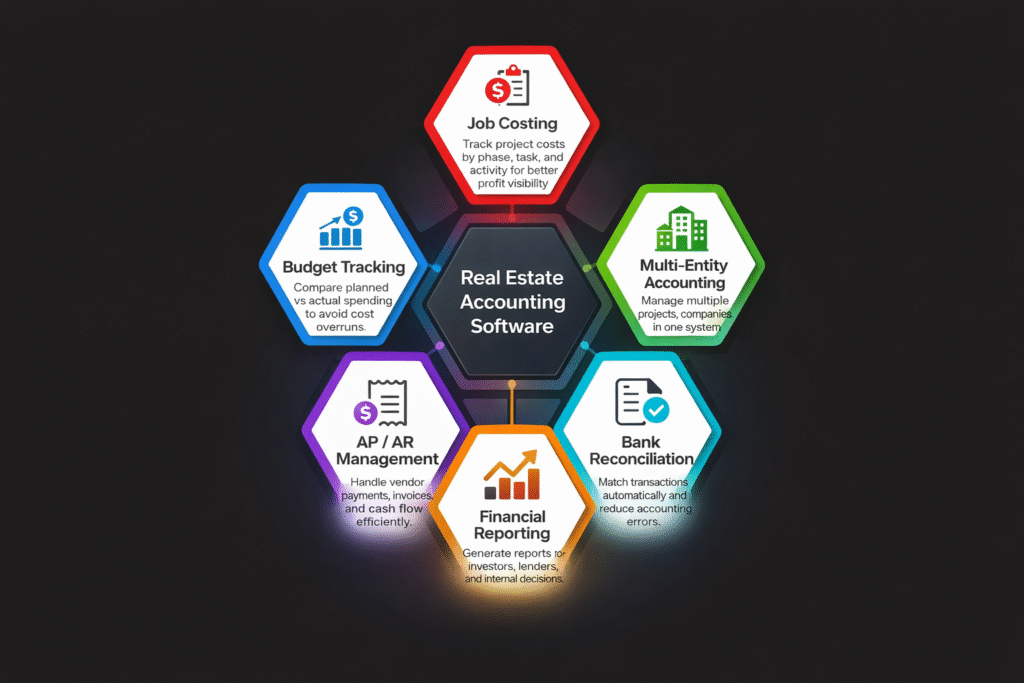
Must-have features table
In this model, the top three features alone make up 50% of the buying decision, which is why developers should shortlist software based first on job costing, budget reporting, and multi-entity capability.
Best Accounting Software for Real Estate Developers
Several tools stand out in current coverage, but they serve different business sizes and workflows. Some are broad accounting platforms adapted for real estate, while others are purpose-built real estate or construction systems.
Top software overview

The fit percentage here is an editorial scoring model for this blog based on how strongly each platform appears aligned with real estate development accounting needs described across the sources, especially job costing, portfolio complexity, and real estate-specific reporting.
QuickBooks Online for Real Estate Developers
QuickBooks Online is one of the most widely known accounting platforms and is often recommended for smaller or established developers who want flexibility, accountant familiarity, and a large integration ecosystem. It is especially useful when the company wants mainstream accounting workflows and plans to connect with external apps for project management or real estate operations.
Its biggest advantage is usability and adoption. Many bookkeepers and CPAs already know QuickBooks, which reduces training friction, but it may need customization or add-ons for deeper project-level development reporting.
QuickBooks score table
| Criteria | Weight % | Score /10 | Weighted Result |
|---|---|---|---|
| Ease of use | 20% | 9 | 1.8 |
| Job costing depth | 20% | 6 | 1.2 |
| Reporting | 15% | 7 | 1.05 |
| Integrations | 15% | 9 | 1.35 |
| Multi-entity support | 15% | 6 | 0.90 |
| Cost efficiency | 15% | 8 | 1.20 |
| Total | 100% | 7.50/10 |
Calculation example: if ease of use is weighted at 20% and scored 9/10, its weighted contribution is 0.20×9=1.80.20×9=1.8. Adding all weighted values gives an estimated overall score of 7.50/10, or 75%.
Xero for Growing Developer Teams
Xero is often praised for user experience, cloud access, team collaboration, and automation-friendly bookkeeping. It can work well for developers who want clean accounting workflows, bank reconciliation, and transparent financial visibility without jumping straight into enterprise software.
Its strength is simplicity with solid accounting foundations. However, like QuickBooks, developers with highly complex project accounting or investor structures may still need extra systems or process customization.

Xero score table
| Criteria | Weight % | Score /10 | Weighted Result |
|---|---|---|---|
| Ease of use | 20% | 9 | 1.8 |
| Job costing depth | 20% | 5 | 1.0 |
| Reporting | 15% | 7 | 1.05 |
| Integrations | 15% | 8 | 1.20 |
| Multi-entity support | 15% | 6 | 0.90 |
| Cost efficiency | 15% | 8 | 1.20 |
| Total | 100% | 7.15/10 |
This equals 71.5%, which makes Xero a practical fit for smaller development businesses that want simple, cloud-first accounting with decent automation but do not require deep construction ERP functionality.
RealPage and Yardi for Large Real Estate Operations
RealPage Accounting is highlighted as a strong overall real estate accounting option because of its property-level reporting, GL drilldowns, and built-in consolidation across entities. Yardi Voyager is often positioned as a more enterprise-ready command center for large real estate firms because it centralizes property accounting, leasing, maintenance, procurement, and more.
These tools are more specialized than general bookkeeping platforms. They are often better for firms that manage large portfolios, complex operations, or mixed workflows across development and ongoing property operations.

Enterprise comparison table
| Software | Real Estate Specificity % | Ease of Use % | Reporting Depth % | Enterprise Suitability % |
|---|---|---|---|---|
| RealPage Accounting | 90% | 72% | 92% | 88% |
| Yardi Voyager | 94% | 65% | 93% | 95% |
| MRI Software | 88% | 70% | 89% | 90% |
This table shows the usual tradeoff: enterprise systems often provide stronger real estate features and reporting, but they can be harder to implement and learn than lighter cloud tools.
Sage 300 CRE and Foundation for Construction-Heavy Development
When development accounting is closely tied to construction cost control, platforms such as Sage 300 Construction and Real Estate and Foundation become more attractive. Current comparisons describe Sage 300 CRE as tailored for construction and real estate with strong job costing, project management, and compliance support, while Foundation is noted for job cost tracking, payroll, and WIP reporting.
These systems are often a better match when the developer directly manages construction-heavy projects and needs tighter operational accounting around labor, subcontractors, budgets, and work in progress.
Construction accounting table
A developer who spends 50% or more of accounting effort on construction cost control may benefit more from these platforms than from general small-business accounting software.

How to Compare Accounting Software Step by Step
Choosing software should not start with price alone. The better approach is to define business complexity first, then match software to your workflow, reporting needs, and growth plans.
A small developer with one or two projects may not need enterprise software. But a developer with multiple entities, active funding relationships, and in-house construction management can quickly outgrow basic tools.
Evaluation framework
| Decision Factor | Weight % | Questions to Ask |
|---|---|---|
| Business complexity | 20% | How many projects, entities, and stakeholders do you manage? |
| Project accounting needs | 20% | Do you need phase-level job costing and draw tracking? |
| Reporting needs | 15% | Do lenders and investors require detailed reports? |
| Team adoption | 15% | Can your staff learn and use it well? |
| Integration needs | 10% | Does it connect with banks, CRM, PM, payroll? |
| Cost | 10% | Is total cost affordable now and later? |
| Scalability | 10% | Can it still work when your portfolio doubles? |
If a software option scores high on the first three categories, it already covers 55% of the core buying decision for many developer businesses.
Pricing Models and Return on Investment
Software pricing varies widely. Some tools use monthly subscription tiers, while enterprise platforms may rely on custom quotes, implementation fees, onboarding charges, and module-based pricing.
This is why developers should measure ROI instead of only subscription cost. A tool that costs more per month may still save money if it reduces accounting labor, improves budget control, speeds draw reporting, and lowers costly financial mistakes.
ROI example table
| Item | Basic Tool | Specialized Tool |
|---|---|---|
| Monthly software cost | $100 | $600 |
| Monthly admin hours saved | 5 | 20 |
| Hourly finance/admin value | $15 | $15 |
| Labor savings | $75 | $300 |
| Error/oversight savings estimate | $25 | $250 |
| Total monthly value | $100 | $550 |
| Net monthly ROI | $0 | -$50 initially |
At first glance the specialized tool looks more expensive, but if it also helps avoid just one budgeting or billing error worth $1,200 over a year, that adds $100 per month in avoided loss, taking monthly value from $550 to $650, which turns the net ROI to +$50 per month. That is a simple example, but it shows why developers should compare total business value, not only subscription price.

Best Software by Business Size
The right tool depends a lot on company size and workflow complexity. A solo or small developer often needs simplicity, while large firms need structure, controls, and reporting power.
Fit by company size
| Business Type | Best-Fit Software Options | Reason | Match % |
|---|---|---|---|
| Small developer | QuickBooks, Xero, Zoho Books | Easy to start, lower complexity | 75% |
| Growing developer | QuickBooks + add-ons, Xero + workflows, RealPage | More reporting and project visibility | 80% |
| Construction-heavy developer | Sage 300 CRE, Foundation | Better job costing and WIP | 88% |
| Large portfolio developer | Yardi Voyager, MRI, RealPage | Multi-entity, deeper reporting | 92% |
Common Mistakes to Avoid
Many developers choose software that is either too simple or too complex. If it is too simple, they outgrow it quickly; if it is too complex, adoption becomes slow and expensive.
Another common mistake is ignoring implementation, migration, and process design. Software alone does not fix poor accounting habits, unclear cost codes, or inconsistent approval workflows.
Mistake impact table
| Mistake | Risk Level % | Why It Hurts |
|---|---|---|
| Choosing on price only | 80% | Can miss critical features later |
| Ignoring job costing | 90% | Weak profit visibility by project |
| No staff training | 70% | Poor adoption and more errors |
| Bad migration planning | 75% | Missing data and reconciliation issues |
| No reporting goals | 65% | Great software, weak decisions |
Final Recommendation
If you are a small real estate developer and want something practical, QuickBooks Online or Xero may be enough to start, especially if your operations are still simple and your accountant already uses those systems. If your projects are more complex or more construction-heavy, Sage 300 CRE, Foundation, or similar specialized platforms may be a better fit because they are stronger in job costing and project accounting.
For large real estate firms handling multiple entities, assets, and stakeholders, RealPage, Yardi Voyager, and MRI Software appear stronger because they are repeatedly described as enterprise-grade and real-estate-focused across current comparisons. In short, the best accounting software for real estate developers is the one that matches your project complexity, reporting needs, and growth stage instead of simply being the cheapest option.
FAQs
What is the best accounting software for real estate developers?
It depends on business size and complexity, but frequently mentioned options include QuickBooks Online, Xero, RealPage, Yardi Voyager, MRI Software, and Sage 300 CRE.
Do real estate developers need special accounting software?
Often yes, because developers usually need job costing, multi-entity books, project-level reporting, and better cash flow control than basic accounting tools provide.
Is QuickBooks good for real estate developers?
Yes for many smaller developers, especially those wanting flexibility and accountant familiarity, but larger or more complex businesses may need more specialized tools.
What features matter most?
Job costing, budget-vs-actual reporting, multi-entity accounting, AP/AR, bank reconciliation, and investor/lender reporting are among the most important features.
Which software is best for large firms?
Yardi Voyager, RealPage, and MRI Software are often positioned as stronger options for large and more complex real estate operations.