
What Are External Threats in Cybersecurity?
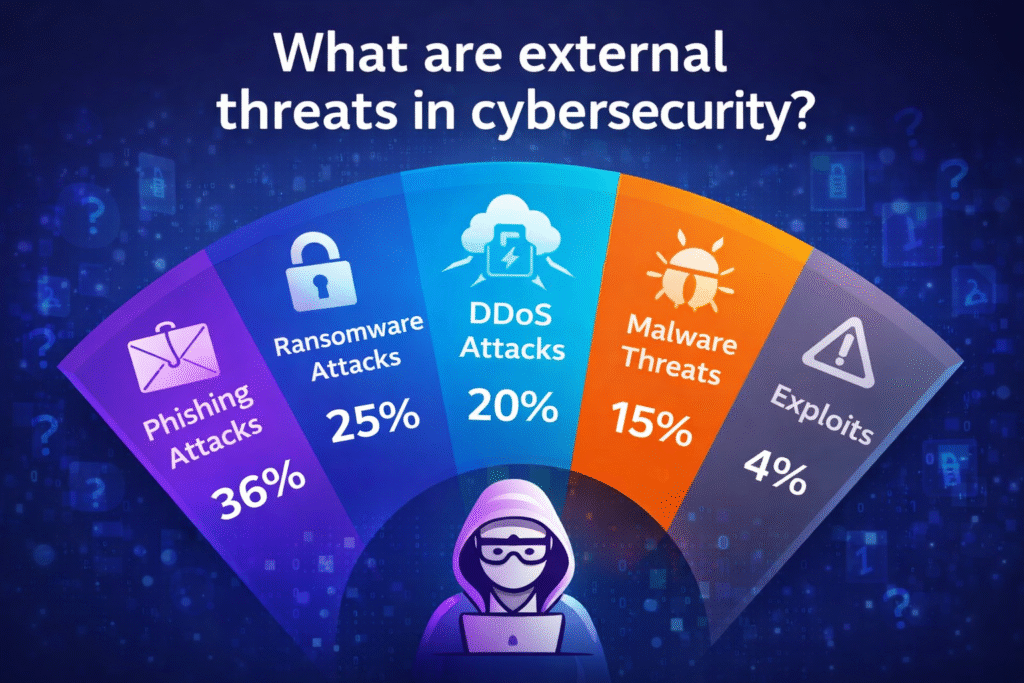
External threats in cybersecurity are responsible for over 70% of cyber attacks in 2026 — and most businesses don’t even realize they’re already vulnerable.
What Are External Threats?
External threats are cyber attacks that originate from actors outside your organization’s control, targeting your digital perimeter like firewalls, websites, or employee devices. Unlike internal threats—such as careless employees or disgruntled insiders—these come from unknown external sources with no legitimate access.c
Key Characteristics of External Threats
- Origin: From the public internet, botnets, or compromised third-party systems.
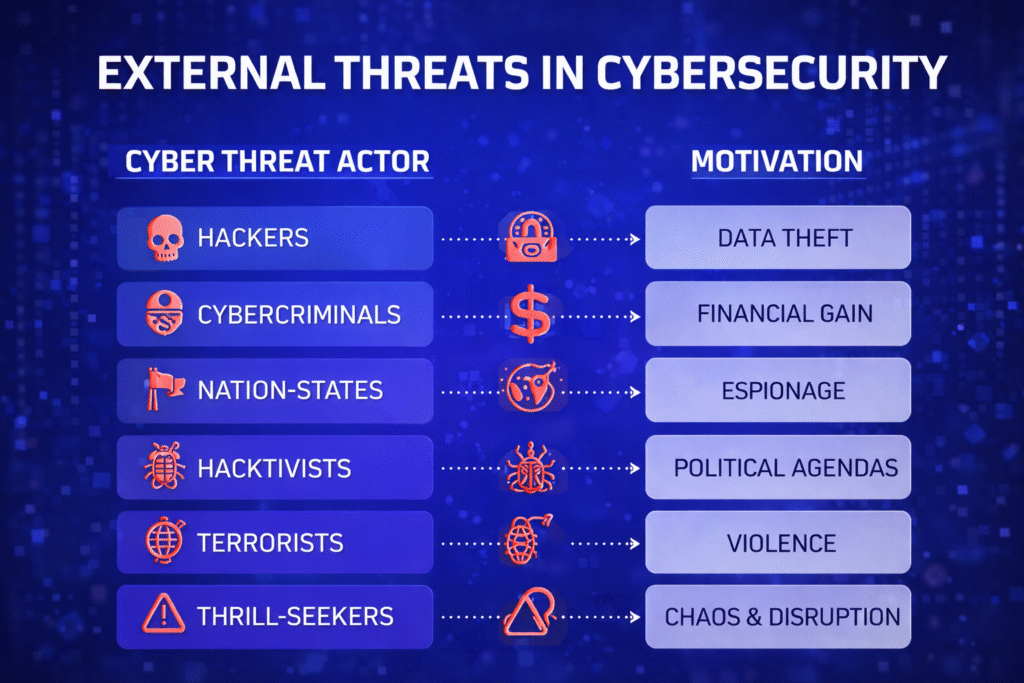
- Motivations: Financial gain (ransomware), espionage (nation-states), disruption (hacktivists), or chaos (script kiddies).
- Methods: Exploit unpatched software, human psychology, or network weaknesses.
- In 2026, external threats account for 70-80% of breaches, up from previous years due to remote work expansion and cloud adoption. They often start with reconnaissance—scanning your public-facing assets like websites or email servers—before escalating to exploitation. For small businesses like Etsy sellers, a single phishing email can expose customer data, leading to compliance fines under GDPR or PCI-DSS.
External vs. Internal Threats
| Aspect | External Threats | Internal Threats |
| Source | Hackers, cybercriminals | Employees, contractors |
| Access Method | Perimeter breaches | Insider privileges |
| Detection Challenge | Harder (unknown actors) | Easier (known users) |
| Common Goal | Theft/disruption | Sabotage/revenge |
Top 7 External Threats in Detail

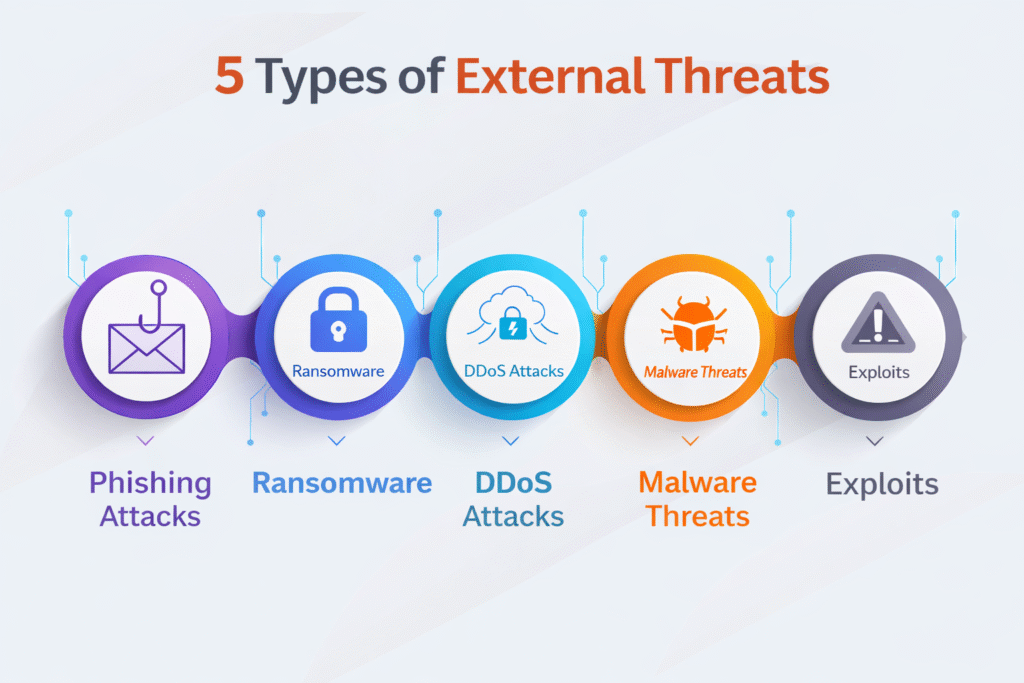
Here are the most prevalent external threats in 2026, each explained with mechanisms, impacts, and statistics.
1. Phishing and Smishing Attacks
Phishing remains the #1 external threat vector, responsible for 36% of all breaches in 2026. Attackers impersonate trusted entities through deceptive emails (phishing) or SMS/text messages (smishing) to trick users into revealing credentials, clicking malicious links, or downloading malware.
How Phishing Works (4-Stage Attack Chain)
1. Reconnaissance: Harvest emails from data breaches, LinkedIn, Etsy seller forums
2. Lure Creation: Craft convincing emails using stolen logos, executive names
3. Delivery: Mass email campaigns or targeted spear-phishing
4. Payload: Fake login pages, malware droppers, or direct ransomware
2026 Phishing Evolution
- AI-Generated Content: ChatGPT creates perfect grammar, personalized emails
- Deepfake Media: Voice cloning for vishing calls; video deepfakes in “urgent Zoom meetings”
- Malicious QR Codes (Quishing): Scanned → malware install
- Smishing Surge: 300% increase via WhatsApp, SMS about “delivery delays”
Spear-Phishing vs Mass Phishing:
| Type | Target | Success Rate | Cost to Attacker |
| Mass Phishing | Everyone | 0.5-1% | $100/campaign |
| Spear-Phishing | Specific Etsy seller | 30-50% | $1,000+ |
Common Phishing Targets for Etsy Sellers
• “Shop suspension notice” → fake login page
• “Customer dispute” → malicious attachment
• “Payment processor alert” → credential theft
• “Plugin update required” → malware dropper
• “Tax authority notice” → ransomware
Attack Anatomy: Business Email Compromise (BEC)
- CEO Fraud: “Send $10K wire transfer to new vendor ASAP – CEO John”
- Vendor Impersonation: “Update your PayPal email to this address”
- 2026 Twist: Voice calls with cloned executive voices (95% convincing)
Real Cost: Average BEC loss = $120,000 per incident; Etsy sellers lose shop access + customer data.
Detection Red Flags
• Urgent language: “Act now or account suspended”
• Generic greetings: “Dear Seller” vs your name
• Mismatched URLs: Hover shows real destination
• Unexpected attachments: .zip, .js, .scr files
• Poor grammar (though AI fixes this now)
• Requests for wire transfers/gift cards
Mobile Smishing Signs: Shortened URLs, odd sender ID, urgent delivery/package alerts.
Impact Statistics
• 5.3 billion phishing emails sent DAILY (2026)
• 1 in 99 emails contain phishing (1.01% rate)
• SMEs lose $25K average per successful attack
• 90% of breaches begin with phishing
• Recovery time: 21 days average
Immediate Prevention for Etsy Sellers
1. Enable 2FA/MFA everywhere (essential)
2. Use email filters: Gmail marks 99.9% suspicious
3. Verify URLs: Always type etsy.com manually
4. Never click email links for passwords
5. Train staff: Forward suspicious emails to IT
6. Use password manager autofill (avoids typing)
Pro Tools:
| Tool | Purpose | Cost |
| Proofpoint | AI email filtering | Enterprise |
| KnowBe4 | Phishing simulations | $20/user/year |
| Google Workspace | Advanced Gmail protection | $6/user/month |
Golden Rule: “If email asks for password/action under pressure → it’s phishing until proven otherwise.”
Etsy-Specific Defense:
• Bookmark etsy.com/seller → never use email links
• Check Etsy app notifications first
• Verify payment issues via Etsy dashboard
• Never share 2FA codes
Key Takeaway: Phishing exploits human psychology, not technology. In 2026, AI makes attacks nearly indistinguishable from legitimate communication. Triple-check before clicking remains your strongest defense.
2. Ransomware
Ransomware has evolved into one of 2026’s most destructive external threats, encrypting victim data and demanding cryptocurrency payment for decryption keys. Attackers now combine encryption with data theft (double extortion), threatening to leak stolen information if ransom isn’t paid.
Ransomware Attack Lifecycle (6 Stages)
1. Initial Access: Phishing email → malware dropper
2. Execution: Ransomware binary runs silently
3. Encryption: All files .encrypted, .lockbit, etc.
4. Exfiltration: Data stolen to attacker C2 servers
5. Ransom Note: “Pay $500K BTC or data published”
6. Negotiation: Dark web chat with attackers
2026 Ransomware Types
| Type | Mechanism | Example Groups |
| Crypto-Ransomware | Encrypts files | LockBit 4.0, BlackCat |
| Leakware/Doxware | Encrypts + leaks data | ALPHV/BlackMatter |
| RaaS (Ransomware-as-a-Service) | Crime-as-a-service model | Conti successors |
| Mobile Ransomware | Locks phone screens | Simplocker variants |
RaaS Revolution: Novice criminals rent ransomware tools, splitting profits 70/30 with developers.
Attack Vectors (Top 5)
1. Phishing (60% of attacks) – Malicious Office docs
2. RDP Brute Force – Weak admin passwords
3. VPN Exploits – Unpatched appliances
4. Supply Chain – Compromised software updates
5. Watering Holes – Infected industry websites
Etsy Seller Scenario: Fake “plugin update” infects shop computer → encrypts customer orders database → “Pay $5K or lose 2026 holiday sales.”
2026 Statistics
• Average ransom demand: $4.5M (up 20% from 2025)
• Average payout: $1.85M
• Daily attacks: 2,200+ globally
• Healthcare hit hardest (25% of attacks)
• Recovery without paying: Only 23% success rate
Double Extortion Impact: Even if you pay, attackers may still leak data for reputation damage.
Detection Warning Signs
• Files renamed with .crypt, .encrypted extensions
• “All your files are encrypted” desktop wallpaper
• Disabled Windows Defender, Task Manager
• Network traffic to unknown Russian/Bulgarian IPs
• Killswitch pings to check if already infected
Immediate Response Protocol
1. Disconnect from network IMMEDIATELY (pull ethernet)
2. Do NOT pay ransom (funds crime, no decryption guarantee)
3. Isolate infected systems
4. Check backups (3-2-1 rule essential)
5. Contact cyber insurance provider
6. Hire forensics (do NOT wipe systems)
Prevention Arsenal
| Defense | Tool/Practice | Effectiveness |
| Backups | 3-2-1 rule, immutable storage | 95% |
| Endpoint Protection | EDR (CrowdStrike) | 85% |
| Network Segmentation | VLANs, micro-segmentation | 90% |
| Patch Management | WSUS, auto-updates | 80% |
| Email Filtering | Proofpoint, Mimecast | 92% |
Etsy Seller Must-Dos:
• Daily automated backups to Google Drive + external HDD
• Never open email attachments from unknown senders
• Use Windows/Mac built-in antivirus (keeps updated)
• Enable Controlled Folder Access (Windows 11)
• Keep shop computer separate from personal use
2026 Reality Check: No backup = ransomware owns you. Groups now target small businesses specifically, knowing SMEs rarely have proper defenses.
Golden Rule: “Good backups beat good ransomware every time.” Test restores monthly—90% of “backup failures” are untested restores.
3. DDoS Attacks
DDoS (Distributed Denial of Service) attacks overwhelm websites and servers with massive fake traffic from botnets, causing outages and lost revenue. In 2026, attacks routinely hit 10 Tbps—enough to crash even large e-commerce platforms.
DDoS Attack Types
| Type | Mechanism | Target Layer |
| Volumetric | Raw bandwidth flood (UDP floods) | Network |
| Protocol | SYN floods, Ping of Death | TCP/IP |
| Application | HTTP floods (slowloris) | Web apps |
| DNS Amplification | Multiplies traffic 50x | DNS servers |
Attack Lifecycle
1. Botnet Recruitment: IoT devices, infected PCs
2. Command & Control: Attacker signals launch
3. Traffic Generation: Millions of zombie devices
4. Target Overload: Legit users see 503 errors
5. Extortion Demand: “Pay $50K BTC or attacks continue”
2026 Trends
- Ransom DDoS (RDDoS): “Pay or we crash your Black Friday sales”
- IoT Botnets: Mirai variants control 2M+ devices
- Etsy Impact: Shop downtime = $1K-$10K/hour lost sales
Real Example: 2025 banking attacks hit 5 Tbps for 48 hours, costing millions.

Detection Signs
• Sudden 500x traffic spike from odd geographies
• UDP/TCP floods from residential IPs
• Slow website response (<1s → 30s)
• Legit customers report “site down”
Prevention Arsenal
| Defense | Tool | Cost |
| Defense | Tool | Cost |
| Always-On Mitigation | Cloudflare Magic Transit | Free-$1K/mo |
| Traffic Scrubbing | AWS Shield, Akamai | $500+/mo |
| Rate Limiting | NGINX, Cloudflare WAF | Free |
| Anycast DNS | Google Public DNS | Free |
Etsy Seller Action:
• Activate Cloudflare Free (absorbs 10 Tbps+)
• Enable “Under Attack Mode” during spikes
• CDN + caching reduces origin load 90%
Key Stat: 99.9% of DDoS attacks are volumetric—modern CDNs stop them cold.
Golden Rule: “Always-on DDoS protection costs $0-$100/month; downtime costs $1K+/hour.” Test your setup during off-peak hours.
4. Malware
Malware (malicious software) encompasses viruses, trojans, worms, and spyware delivered via external attack vectors like phishing emails, drive-by downloads, or compromised websites. In 2026, fileless malware evading traditional antivirus dominates, with 630,000 new samples daily.
Malware Types Matrix
| Type | Behavior | Delivery Method |
| Virus | Attaches to legit files | Email attachments |
| Trojan | Fake software (plugin updates) | Software downloads |
| Worm | Self-spreads network | RDP exploits |
| Spyware | Keyloggers, screen capture | Bundled installers |
| Rootkit | Hides other malware | Privilege escalation |
| Fileless | Lives in RAM only | PowerShell scripts |
Infection Vectors (Top 4)
1. Phishing attachments (.js, .scr, .zip)
2. Compromised WordPress plugins (80% of Etsy sites)
3. Drive-by downloads (visit infected site)
4. USB drops in parking lots
Etsy Seller Nightmare: Fake “SEO plugin” → trojan → steals customer database → shop defaced with crypto scams.
2026 Evolution
• Fileless attacks: 77% evasion vs signature AV
• AI-generated polymorphic code
• Living-off-the-land: Uses Windows tools (PowerShell)
• Cross-platform: Windows/Mac/Android
Detection Indicators
• 50% CPU usage (crypto miner)
• Browser homepage hijacked
• Unknown processes (svchost.exe fakes)
• Disabled Windows Defender
• Ransomware precursors (network scans)
Defense Stack
| Layer | Tool | Effectiveness |
| Next-Gen AV | Windows Defender + Malwarebytes | 92% |
| Behavior Monitoring | EDR (CrowdStrike Falcon) | 97% |
| Application Whitelisting | AppLocker | 99% |
| Regular Scans | ESET Online Scanner | Free |
Etsy Seller Checklist:
• Enable Windows Defender real-time protection
• Install Malwarebytes (free version)
• Block macros in Office docs
• Never run .exe from email
• Chrome Safe Browsing enabled
Critical Stat: 94% of malware uses obfuscation—signature antivirus fails. Behavioral detection + whitelisting = modern defense.
Golden Rule: “One infected plugin kills your shop. Update weekly, scan daily, whitelist ruthlessly.”
5. Vulnerability Exploits
What Are Vulnerability Exploits?
A vulnerability is a flaw or weakness in software, hardware, or configurations that attackers can abuse. An exploit is malicious code or techniques specifically crafted to take advantage of that flaw, often leading to severe consequences like data theft or full system takeover.
Simple analogy: Think of vulnerabilities as cracks in your home’s foundation. Exploits are the crowbars attackers use to widen those cracks and break in.
2026 Reality: Vulnerability exploitation now causes 20% of all breaches (up 34% from 2025), nearly matching phishing as the top attack vector. Attackers weaponize flaws within 5 days of disclosure—sometimes within 24 hours.
How Vulnerability Exploits Work (5-Stage Lifecycle)
1. Discovery: Attackers scan with Nmap or buy intel on dark web
2. Exploit Development: Code crafted (Metasploit, custom scripts)
3. Delivery: Phishing, watering holes, direct network attacks
4. Execution: Code runs, gaining initial access
5. Escalation: Privilege escalation → lateral movement → persistence
Types of Vulnerability Exploits
Remote Code Execution (RCE)
Most dangerous type—attackers run arbitrary code remotely without physical access.
- Example: Log4Shell (CVE-2021-44228) affected millions of Java apps; 2025’s SAP NetWeaver (CVE-2025-31324) hit enterprises.
- Impact: Complete server takeover
Zero-Day vs N-Day Exploits
| Type | Description | Patch Available? | Cost on Dark Web |
| Zero-Day | Unknown to vendor | ❌ No | $10K-$500K |
| N-Day | Publicly known | ✅ Yes (but unpatched systems) | $100-$10K |
Zero-days: 75 exploited in 2024; enterprise VPNs/firewalls = 44% targets.
Common Exploit Categories
Buffer Overflow: Overload memory → crash or code execution [web:45]
SQL Injection: Malicious SQL via web forms → database dump
XSS (Cross-Site Scripting): Malicious scripts in websites
Privilege Escalation: User → admin/root access
2026 High-Risk Vulnerabilities
| CVE | Target | CVSS Score | Status |
| CVE-2025-3248 | Langflow AI | 9.8 Critical | Actively Exploited |
| CVE-2025-53770/53771 | MS SharePoint | 9.8 Critical | Government Targets |
| CVE-2025-20393 | Cisco Email Gateway | 10.0 Critical | No Patch |
Real-World Impact on Businesses
Etsy Seller Scenario: Unpatched WordPress plugin → exploit → shop defacement → customer database stolen → PCI-DSS fines ($100K+).
Enterprise Cost: Average breach from exploits = $4.8M; 23,600+ CVEs published in H1 2025 alone.
Most Targeted: Network edge devices (firewalls/VPNs), WordPress, open source libraries.

Attackers’ Tools Arsenal
• Nmap (scanning)
• Metasploit Framework (ready exploits)
• Burp Suite (web app testing)
• Shodan (internet-connected devices)
• Exploit-DB (public exploits)
Prevention: Vulnerability Management Framework
1. Continuous Scanning
• Nessus/Tenable: Automated vulnerability scans
• Qualys: Cloud-based scanning
• OpenVAS: Free alternative
Pro Tip: Scan weekly, prioritize CVSS 7.0+ flaws.
2. Patch Management Priority
Day 0: Critical (CVSS 9.0+) → Patch within 24hrs
Day 7: High (CVSS 7.0-8.9) → Patch within 7 days
Day 30: Medium → Patch within 30 days
Reality Check: 69% of exploited vulns required NO authentication—patch them first.
3. CISA KEV Catalog
Government list of “Known Exploited Vulnerabilities”—patch these immediately.
4. Network Segmentation
Limit blast radius: Compromised web server can’t reach databases.
5. Web Application Firewall (WAF)
Cloudflare/AWS WAF blocks 85% of injection attacks.
6. Threat Intelligence Feeds
• AlienVault OTX (free)
• Recorded Future
• CISA Alerts
Etsy Seller Action Plan (Practical)
1. Update WordPress + ALL plugins weekly
2. Use security plugins: Wordfence, Sucuri
3. Enable auto-updates
4. Hide wp-admin URL
5. WAF via Cloudflare (free tier)
6. Regular backups (UpdraftPlus)
Detection Signs
• Unusual traffic spikes to admin pages
• New unknown files in /wp-content/uploads/
• Database errors after form submissions
• Google blacklisting warnings
• SIEM alerts (if you have one)
6. Social Engineering
Manipulates humans: Pretexting, baiting, quid pro quo.
Tactics: Fake tech support calls, USB drops.
7. Supply Chain Attacks
Compromise vendors to hit customers (e.g., Kaseya 2025).
Risk: Third-party code in Etsy integrations.
Real-World Examples from 2025-2026
- Colonial Pipeline Ransomware (Evolved): 2025 variant shut fuel supplies; $100M payout avoided via backups.
- Massive DDoS on Banks: 5 Tbps attack via Mirai botnet; services down 48 hours.
- MOVEit Supply Chain: Breached 60M users via file transfer flaw.
- AI Phishing Wave: Deepfake CEOs tricked execs into $25M transfers.
These show external threats’ global scale.
Prevention Strategies
Layered defenses are key (defense-in-depth).
Core Tools and Best Practices
- Email Security: SPF/DKIM/DMARC; AI filters block 99% phishing.
- Endpoint Protection: EDR (CrowdStrike), next-gen AV.
- Network Defenses: Firewalls (Palo Alto), IDS/IPS, zero-trust (Zscaler).
- Backups: 3-2-1 rule (3 copies, 2 media, 1 offsite); immutable storage.
- Training: Annual simulations; 90% behavior change.
- Threat Intelligence: Feeds from AlienVault OTX.
- Patching: Automate; prioritize CVEs.
Detailed Prevention Table
| Threat | Tools/Practices | Effectiveness | Cost Estimate |
| Phishing | Proofpoint, KnowBe4 training | 95% | $10/user/yr |
| Ransomware | Veeam backups, segmentation | 90% | $5K/yr |
| DDoS | Cloudflare/Imperva scrubbing | 99% | $1K/mo |
| Malware | Microsoft Defender, patch management | 85% | Free-$2K |
| Exploits | Nessus scans, zero-days via CISA | 80% | $3K/yr |
| Social Eng. | MFA everywhere (e.g., Duo) | 99% | $5/user/mo |
| Supply Chain | Vendor risk mgmt (Bitsight), SBOMs | 75% | $10K/yr |
For Etsy Sellers: Enable 2FA, use VPNs, audit plugins.
Incident Response Plan:
- Identify (SIEM alerts).
- Contain (isolate).
- Eradicate (forensics).
- Recover (test backups).
- Lessons Learned.
Future Trends in 2026 and Beyond
- AI-Driven Attacks: Autonomous malware.
- Quantum Threats: Breaking encryption.
- 5G/IoT Expansion: More attack surfaces.
- Regulations: Stricter NIS2, SEC rules.
Stay ahead with continuous monitoring.
FAQS
1. What is the difference between external and internal cyber threats?
External threats come from outside actors (hackers, cybercriminals) targeting your network perimeter, while internal threats originate from employees or insiders with legitimate access. External attacks focus on phishing and exploits (70-80% of breaches); internal often involve accidental leaks or sabotage.
2. Which external threat causes the most breaches in 2026?
Phishing/smishing leads with 36% of breaches, using AI-generated emails and SMS to steal credentials. It’s the top entry point for ransomware and malware because it exploits human psychology over technical defenses.
3. How can small businesses like Etsy sellers prevent ransomware?
Follow the 3-2-1 backup rule (3 copies, 2 media types, 1 offsite/immutable), enable Controlled Folder Access, and segment networks. Never pay ransoms—tested backups restore 95% of victims without funding crime.
4. What are zero-day vulnerability exploits and how to stop them?
Zero-days are undisclosed flaws attackers exploit before patches exist, costing $10K-$500K on dark web. Mitigate with weekly Nessus scans, CISA KEV catalog patching, and zero-trust segmentation to limit damage.
5. How does DDoS affect e-commerce sites like Etsy shops?
DDoS floods servers with 10 Tbps traffic, causing downtime and $50K+ lost sales per hour. Use Cloudflare/AWS Shield scrubbing services (free tiers available) to filter malicious traffic automatically.
6. Why are supply chain attacks dangerous for small businesses?
Attackers compromise trusted vendors (plugins, payment processors), bypassing your defenses to hit customers. Audit third-party code with SBOMs, use vendor risk tools like Bitsight, and prefer established plugins.
7. What is the #1 action every business should take today against external threats?
Enable multi-factor authentication (MFA/2FA) everywhere—it blocks 99% of credential-based attacks like phishing and privilege escalation. Combine with email filtering and auto-patching for 80% risk reduction.
Conclusion
External threats in cybersecurity represent the frontline battle against sophisticated actors who exploit every weakness to steal data, disrupt operations, and extort payments. From AI-powered phishing (36% of breaches) and double-extortion ransomware ($4.5M average cost) to zero-day vulnerability exploits and massive DDoS attacks, 2026 demands proactive defense over reaction.
Key Takeaways for Immediate Action:
- Layered Defense: Combine backups, patching, email filtering, and zero trust—single tools fail against evolved threats.
- Etsy Seller Priority: Enable 2FA everywhere, use Cloudflare WAF (free tier), maintain daily immutable backups, and never click unsolicited links.
- Business Reality: 70-80% of breaches are external; unpatched systems and human error remain top vulnerabilities.
The cost of prevention ($5K-$20K annually for SMEs) pales against breach recovery ($4.8M average). Forward-thinking organizations win by treating security as operational necessity, not IT afterthought.
Final Call to Action: Audit your perimeter today—patch critical CVEs within 24 hours, test backups monthly, train your team quarterly. In cybersecurity’s endless arms race, vigilance separates survivors from victims.