
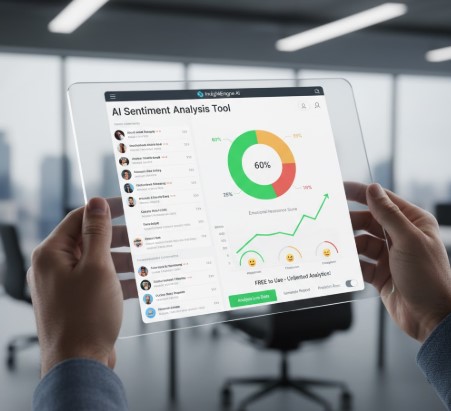
AI Sentiment Analysis Tools: The Complete Guide
In today’s digital world, people share their opinions everywhere — on social media, reviews, emails, chats, and surveys. But reading and understanding thousands or millions of opinions manually is impossible.
This is where AI sentiment analysis tools come in.
These tools use artificial intelligence and natural language processing (NLP) to understand human emotions, opinions, and attitudes at scale.
In this detailed guide, you’ll learn:
✔ What AI sentiment analysis tools are
✔ How they work
✔ Why they are important
✔ Key features
✔ Use cases across industries
✔ Benefits & limitations
✔ Future trends
What Is Sentiment Analysis?
Sentiment analysis is the process of identifying the emotional tone behind a piece of text.
It typically classifies text as:
• Positive
• Negative
• Neutral
Advanced AI tools can also detect:
• Anger
• Happiness
• Frustration
• Excitement
• Sarcasm
What Is an AI Sentiment Analysis Tool?
An AI sentiment analysis tool is software that uses:
• Machine learning
• Natural language processing (NLP)
• Deep learning
• Large language models
To automatically analyze text data and determine how people feel about a topic, brand, product, or service.
Why AI Sentiment Analysis Tools Are Important
Without sentiment analysis:
❌ You guess what customers feel
❌ You miss early warning signs
❌ You react too late to negative feedback
With AI sentiment analysis:
✔ You understand customer emotions instantly
✔ You improve products and services
✔ You protect brand reputation
✔ You make data-driven decisions
How AI Sentiment Analysis Tools Work
Step-by-Step Process:
1️⃣ Data Collection
Text is gathered from reviews, social media, chats, surveys, emails, etc.
2️⃣ Text Preprocessing
AI cleans data (removes emojis, slang, stop words, noise).
3️⃣ Natural Language Processing (NLP)
The system understands grammar, context, and meaning.
4️⃣ Machine Learning Models
Trained models classify sentiment using patterns and probabilities.
5️⃣ Sentiment Scoring & Insights
Results are shown as dashboards, scores, and trends.
Types of Sentiment Analysis
1️⃣ Polarity-Based Sentiment Analysis
Classifies text as:
• Positive
• Negative
• Neutral
Used for basic reviews and feedback.
2️⃣ Emotion-Based Sentiment Analysis
Detects specific emotions like:
• Joy
• Anger
• Sadness
• Fear
Useful for deeper customer understanding.
3️⃣ Aspect-Based Sentiment Analysis
Analyzes sentiment for specific features.
Example:
“Battery life is great, but the camera is bad.”
AI detects:
• Battery → Positive
• Camera → Negative
4️⃣ Intent-Based Sentiment Analysis
Identifies user intention, such as:
• Purchase intent
• Complaint intent
• Churn risk
Use Cases of AI Sentiment Analysis Tools
Customer Reviews & Feedback
• Analyze product reviews
• Identify pain points
• Improve product quality
Social Media Monitoring
• Track brand sentiment
• Detect viral negativity early
• Measure campaign reactions
Customer Support
• Analyze chat & email tone
• Detect frustrated customers
• Prioritize urgent cases
Market Research
• Understand audience opinions
• Analyze survey responses
• Identify trends
HR & Employee Feedback
• Analyze employee surveys
• Measure workplace morale
• Detect burnout signals
Politics & Public Opinion
• Monitor public sentiment
• Analyze speeches & media
Key Features of AI Sentiment Analysis Tools
✔ Real-time sentiment detection
✔ Multilingual support
✔ Emotion classification
✔ Trend analysis
✔ Custom dashboards
✔ API integration
✔ Scalable processing
Benefits of AI Sentiment Analysis Tools
✔ Saves time & cost
✔ Processes massive data
✔ Improves customer experience
✔ Enhances brand reputation
✔ Supports smarter decisions
✔ Reduces human bias
Limitations of AI Sentiment Analysis
❌ Difficulty understanding sarcasm
❌ Cultural language differences
❌ Context misinterpretation
❌ Requires quality training data
👉 Human review is still important for critical decisions.
AI Sentiment Analysis vs Manual Analysis
| Feature | Manual Analysis | AI Analysis |
|---|---|---|
| Speed | Slow | Instant |
| Scalability | Limited | Massive |
| Consistency | Varies | High |
| Cost | High | Lower |
| Accuracy | Subjective | Data-driven |
Is Sentiment Analysis Safe & Ethical?
Responsible tools:
✔ Respect privacy
✔ Anonymize data
✔ Follow compliance laws
Ethical use is critical, especially for:
• Personal data
• Employee feedback
• Healthcare & finance
Future of AI Sentiment Analysis Tools
The future will include:
• Better sarcasm detection
• Voice & video sentiment analysis
• Real-time emotional intelligence
• Multimodal sentiment analysis
• AI-driven decision automation
Sentiment analysis will move from insight → action.
Who Should Use AI Sentiment Analysis Tools?
✔ Businesses
✔ Marketers
✔ Product teams
✔ Customer support teams
✔ HR professionals
✔ Researchers
✔ Governments
If opinions matter to your success — sentiment analysis matters.
FAQs (Trending on Google)
❓ What is an AI sentiment analysis tool?
It’s software that uses AI and NLP to analyze emotions and opinions in text data.
❓ Is sentiment analysis accurate?
Modern AI tools are highly accurate but still benefit from human validation.
❓ Can AI detect emotions?
Yes. Advanced tools detect emotions like anger, joy, and frustration.
❓ Does sentiment analysis work in multiple languages?
Yes. Many tools support dozens of languages.
❓ Is sentiment analysis used on social media?
Yes. It’s widely used for brand and reputation monitoring.
❓ Can small businesses use sentiment analysis?
Absolutely. Many tools are affordable or freemium.
❓ Can AI analyze voice sentiment?
Yes. Emerging tools analyze voice tone and emotion.
❓ Will AI replace human analysts?
No. AI supports analysts but doesn’t replace human judgment.
Final Thoughts
AI sentiment analysis tools help organizations listen at scale.
In a world full of opinions, the winners are those who:
✔ Understand emotions
✔ Act quickly
✔ Make smarter decisions
AI doesn’t just read words — it understands feelings.
As technology evolves, sentiment analysis will become a core intelligence layer for every business.