
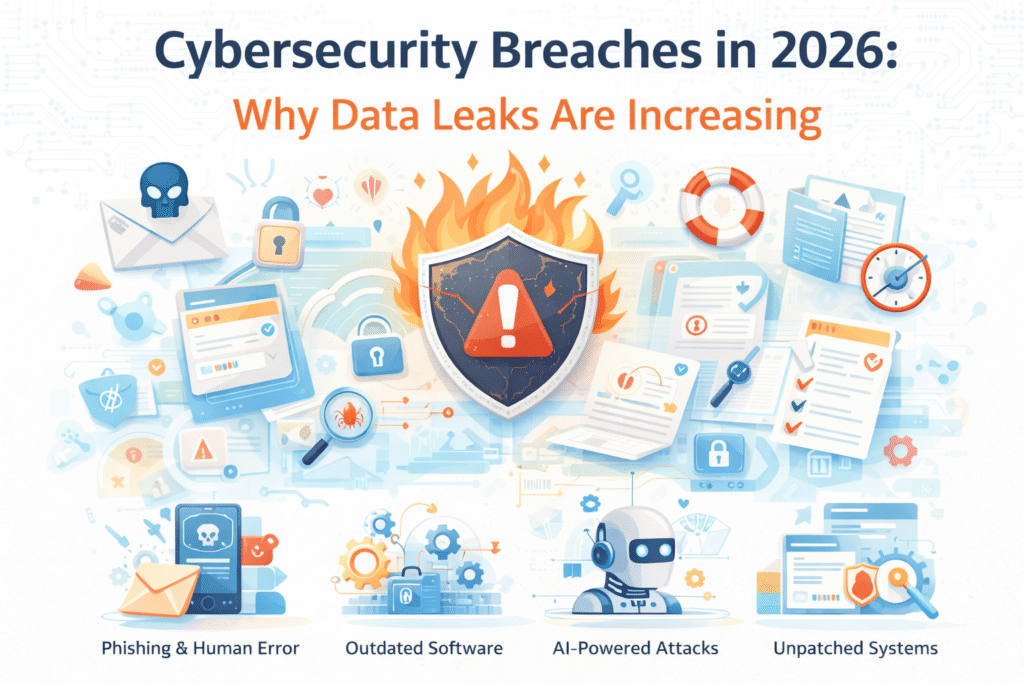
In 2026, cybersecurity has become one of the most critical challenges for businesses, governments, and individuals. Every day, headlines reveal new data breaches exposing millions of records—emails, passwords, financial details, medical histories, and even national infrastructure data. Despite advancements in security technology, cyberattacks are increasing in both frequency and impact.
The reason is simple: digital systems are growing faster than security awareness. Businesses are adopting cloud platforms, AI tools, remote work systems, and connected devices at record speed. Each new tool adds convenience—but also introduces new vulnerabilities. Hackers no longer rely on complex techniques alone; they exploit small oversights, outdated software, and human mistakes.
Cybersecurity in 2026 is no longer just an IT issue—it is a business survival issue.
The Growing Attack Surface of the Digital World
Every digital transformation expands what experts call the “attack surface.” In 2026, organizations use:
- Cloud platforms
- Remote work environments
- IoT devices
- AI-driven tools
- Third-party integrations
- APIs and automation systems
Each of these systems creates a potential entry point. Hackers don’t always break in through the front door—they slip through forgotten admin accounts, unpatched plugins, misconfigured servers, and old software versions.
The more tools a business uses, the more complex its security becomes. Small businesses, startups, and even freelancers now operate on the same digital scale as large enterprises—but without the same security budgets or expertise.
Outdated Systems and the Patch Problem
One of the biggest reasons data leaks are increasing in 2026 is simple: systems are not updated on time. Security patches are released daily across operating systems, firewalls, plugins, and applications. Yet many organizations delay updates due to:
- Fear of breaking systems
- Lack of IT resources
- Poor awareness
- Manual update processes
Hackers monitor public vulnerability disclosures. When a flaw is announced, attackers immediately scan the internet for systems that haven’t been patched. This creates a race between security teams and cybercriminals—and too often, attackers win.
Auto-updates and managed patching are becoming essential, not optional.
Human Error: The Weakest Link
Even with strong technical defenses, human behavior remains the most exploited weakness. In 2026, most breaches still begin with:
- Phishing emails
- Fake login pages
- Malicious attachments
- Social engineering
- Reused passwords
Attackers no longer rely on brute force. They manipulate trust. A single click by an employee can open the door to an entire network. As AI-generated phishing becomes more realistic, even trained professionals fall victim.
Cybersecurity is no longer just about firewalls—it’s about behavior, training, and culture.
The Rise of Automated and AI-Powered Attacks
Hackers now use AI to:
- Generate convincing phishing messages
- Scan for vulnerabilities at scale
- Automate exploitation
- Adapt attacks in real time
- Evade detection systems
This automation allows small attacker groups to launch massive campaigns. What once required teams of experts can now be executed by scripts and AI agents. As defenders adopt AI, attackers do the same—creating an arms race in cyberspace.
The True Cost of a Data Breach
In 2026, a data breach is not just a technical event—it is a business crisis. Consequences include:
- Financial losses
- Regulatory penalties
- Brand damage
- Customer trust erosion
- Legal action
- Operational downtime
For small businesses, a single breach can be fatal. Many never recover. Customers are more aware than ever, and trust is fragile. Security is now part of brand reputation.
How Businesses Can Reduce Risk in 2026
To survive in this environment, organizations must treat cybersecurity as a core strategy, not an afterthought. Key actions include:
- Enabling automatic updates for all systems
- Using managed firewalls and endpoint protection
- Enforcing multi-factor authentication
- Training employees regularly
- Monitoring systems in real time
- Limiting access based on roles
- Backing up data securely
Security is no longer about perfection—it’s about resilience. The goal is not to avoid every attack, but to detect, contain, and recover quickly.
The Future of Cybersecurity
Cybersecurity in 2026 is moving toward zero-trust models, AI-driven defense systems, and continuous monitoring. Organizations that treat security as part of culture—not just infrastructure—will thrive. Those who ignore it will become headlines.
Data is the new currency. Protecting it is no longer optional.
FAQs
Why are cybersecurity breaches increasing in 2026?
Breaches are rising because digital systems are expanding faster than security practices. Businesses adopt cloud tools, AI platforms, and remote work systems rapidly, often without proper configuration or updates. Hackers exploit these gaps using automated tools and AI-driven attacks.
What is the most common cause of data leaks?
The most common causes are unpatched vulnerabilities and human error. Outdated software provides easy entry points, while phishing and social engineering trick users into granting access. Most breaches begin with a simple mistake.
Are small businesses more at risk than large companies?
Yes. Small businesses often lack dedicated security teams and rely on default configurations. Hackers know this and target them heavily. In many cases, small businesses store just as much sensitive data as large enterprises.
How does AI change cyberattacks?
AI enables attackers to automate scanning, exploit vulnerabilities faster, and craft realistic phishing messages. This increases attack scale and sophistication. At the same time, defenders are using AI for detection and response, creating a constant battle.
What is the most effective defense strategy in 2026?
The most effective strategy combines automatic updates, multi-factor authentication, employee training, continuous monitoring, and zero-trust principles. Security must be proactive, automated, and embedded into daily operations.
Can data breaches ever be fully prevented?
No system is perfectly secure. The goal is not absolute prevention, but resilience—detecting threats quickly, limiting damage, and recovering fast. Businesses that plan for breaches survive; those that ignore them fail.