
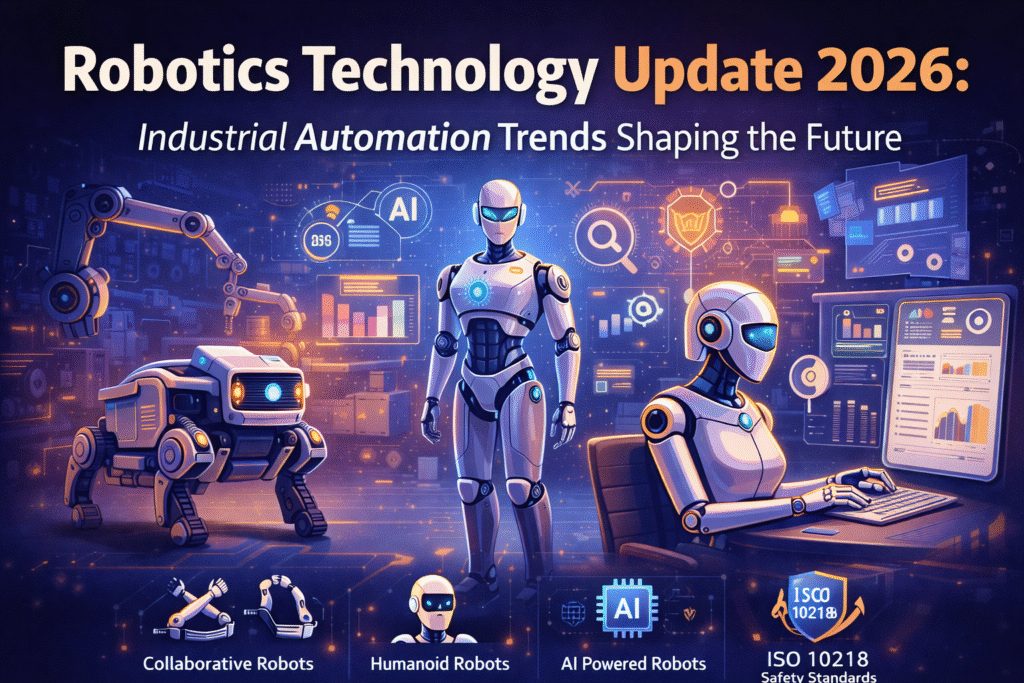
The year 2026 represents a defining moment for robotics and industrial automation. What was once considered futuristic is now becoming standard practice across factories, warehouses, healthcare facilities, and even retail environments. Robots are no longer limited to repetitive mechanical tasks; they are intelligent, adaptive systems capable of learning, analyzing, and collaborating with humans. With the integration of artificial intelligence and the introduction of advanced safety standards like ISO 10218, automation is becoming safer, more flexible, and more accessible than ever before.
Industrial automation is no longer exclusive to large corporations. Small and medium-sized businesses are now adopting robotics to improve productivity, reduce operational costs, and stay competitive in fast-changing markets. From autonomous mobile robots in logistics to humanoid robots assisting in complex environments, the robotics landscape in 2026 is built around flexibility, safety, and human collaboration.
The Rise of Smart and Collaborative Robots
One of the most impactful trends in 2026 is the widespread adoption of collaborative robots, or “cobots.” Unlike traditional industrial robots that operate behind cages, cobots are designed to work directly alongside humans. They can sense movement, control force, and stop instantly if a person enters their workspace. This makes them ideal for tasks such as packaging, assembly, inspection, and material handling.
What sets modern cobots apart is their intelligence. Powered by AI, they can learn tasks by observing humans, adapt to new workflows, and optimize processes in real time. Businesses can deploy them without redesigning entire production lines. This flexibility reduces setup costs and makes automation viable even for small workshops and local manufacturers.
Autonomous Mobile Robots Redefining Logistics
Warehouses and distribution centers are undergoing a transformation through Autonomous Mobile Robots (AMRs). These robots navigate using sensors, cameras, and AI-based mapping systems. Unlike older automated guided vehicles that follow fixed paths, AMRs dynamically adjust their routes, avoid obstacles, and optimize movement in real time.
In 2026, AMRs are central to e-commerce, retail, and manufacturing operations. They handle inventory movement, order picking, and internal logistics with minimal human supervision. This results in faster fulfillment, fewer errors, and reduced dependency on manual labor. As global supply chains face labor shortages, AMRs provide a scalable and reliable alternative.
Humanoid and Multi-Legged Robots Enter Industry
A major breakthrough in 2026 is the entry of humanoid and four-legged robots into industrial environments. These robots are built to function in spaces designed for humans. They can climb stairs, open doors, and navigate uneven surfaces, making them ideal for factories, construction sites, and inspection zones.
Rather than replacing workers, these robots support them in hazardous or physically demanding tasks. They conduct safety inspections, monitor infrastructure, and perform maintenance in environments unsafe for humans. Their human-like form allows them to integrate into existing facilities without costly infrastructure changes.
Safety Standards Shaping the Automation Era
As robots increasingly work alongside humans, safety has become a top priority. Updated global standards such as ISO 10218 define how industrial robots should be designed and operated. These guidelines ensure robots can function safely in shared environments.
Modern robots now feature force-limited joints, real-time collision detection, and AI-driven risk assessment. These innovations reduce accidents and build trust in automation. Industries such as healthcare, food processing, and small manufacturing—once hesitant to adopt robotics—are now embracing automation with confidence.
Artificial Intelligence as the Brain of Automation
AI is the core driver behind modern robotics. In 2026, robots no longer follow fixed scripts. They analyze data, recognize patterns, and make decisions. AI enables robots to detect defects, predict maintenance needs, adapt to new tasks, and optimize workflows.
This shift from rigid automation to intelligent systems allows companies to respond quickly to market changes. Production lines can be reconfigured within hours, and robots can handle customized or low-volume orders efficiently. Automation becomes dynamic rather than static.
Workforce Transformation in the Age of Robots
Automation in 2026 is not about eliminating jobs—it is about redefining them. Repetitive and physically demanding tasks are increasingly handled by robots, while humans focus on creativity, supervision, and strategic thinking.
New roles are emerging, including:
- Robot supervisors
- Automation technicians
- AI system operators
- Data-driven production managers
Organizations that invest in reskilling programs are seeing higher productivity and stronger employee engagement. The future workforce is hybrid, built on collaboration between humans and machines.
How Businesses Can Prepare for the Future
To remain competitive, businesses must begin preparing now. This involves identifying processes suitable for automation, investing in scalable robotic solutions, training employees in AI and robotics fundamentals, and prioritizing safety-first implementation.
Companies that adopt flexible automation gain resilience and efficiency. As robotics technology becomes more affordable, it will become as essential as computers in the workplace. Early adopters will lead the next industrial transformation.
The Road Ahead
Robotics in 2026 is defined by intelligence, collaboration, and accessibility. Industrial automation is no longer about replacing people—it is about empowering them. With smart robots, evolving safety standards, and AI-driven decision-making, industries are entering a new era where productivity, safety, and innovation grow together.
The future belongs to businesses that embrace robotics as a strategic partner. Those who adapt today will shape tomorrow’s industrial revolution.
FAQs
What are the biggest robotics trends in 2026?
The biggest trends include collaborative robots working alongside humans, widespread use of autonomous mobile robots in logistics, and the introduction of humanoid and multi-legged robots in industrial environments. AI integration is transforming robots from task-followers into intelligent systems capable of learning, adapting, and optimizing workflows in real time.
How is industrial automation changing small businesses?
Automation is no longer limited to large factories. Affordable cobots and AMRs allow small businesses to improve efficiency, reduce errors, and scale operations. Tasks like packaging, inventory movement, and inspection can now be automated without major infrastructure changes, making robotics accessible to workshops and SMEs.
Are robots replacing human jobs in 2026?
Robots are not replacing humans; they are reshaping roles. Repetitive and hazardous tasks are automated, while humans focus on creativity, problem-solving, and supervision. New careers in robotics, AI operations, and automation management are emerging, creating a more skilled and flexible workforce.
What role does AI play in modern robotics?
AI acts as the brain of modern robots. It enables machines to understand environments, make decisions, learn new tasks, and optimize operations. AI-driven robots can predict maintenance needs, detect defects, and adapt to changing production demands, making automation smarter and more responsive.
Why are safety standards like ISO 10218 important?
Safety standards ensure robots can operate reliably around humans. ISO 10218 defines how industrial robots should be designed and used to prevent accidents. Features like collision detection and force limitation make automation safe for shared environments, encouraging adoption across more industries.
How should businesses prepare for robotics in the future?
Businesses should assess processes that can benefit from automation, invest in scalable robotic solutions, train employees in AI and robotics basics, and implement safety-first strategies. Early preparation ensures long-term competitiveness and smoother integration of future technologies.