
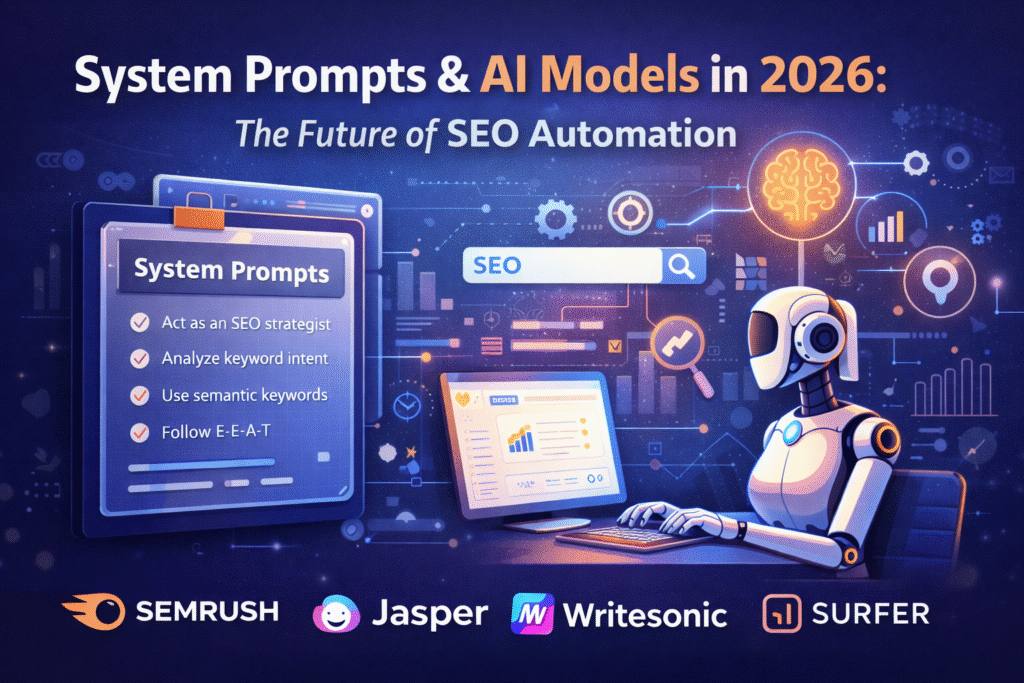
In 2026, SEO is no longer powered only by keywords, backlinks, and manual research. The real engine behind modern SEO tools is artificial intelligence—specifically system prompts and AI models. These two components define how platforms like Semrush, Jasper, Writesonic, Surfer, and other AI-powered tools analyze search intent, generate content, and optimize pages. System prompts act as hidden instructions that guide how an AI behaves, while AI models serve as the intelligent core that understands language, context, and ranking patterns.
Together, they transform generic AI into a specialized SEO expert that can write blogs, audit websites, cluster keywords, and predict ranking opportunities with incredible accuracy.
What Are System Prompts in AI SEO Tools?
A system prompt is an invisible instruction layer that tells an AI how to behave. It defines rules, tone, goals, and boundaries. In SEO tools, system prompts instruct the AI to behave like a professional SEO strategist. They may include rules such as following Google’s E-E-A-T principles, matching search intent, avoiding keyword stuffing, and structuring content for rankings.
For example, when an AI tool generates a blog, the system prompt may say:
“Act as an expert SEO strategist. Analyze search intent. Use semantic keywords. Write helpful, human-friendly content optimized for ranking.”
This is what turns a general AI into a focused SEO assistant.
How AI Models Power SEO in 2026
AI models are the “brains” behind these tools. In 2026, most platforms use large language models (LLMs) trained on massive datasets of web content, search behavior, and linguistic patterns. These models understand:
- Search intent
- Semantic relationships between keywords
- Content quality signals
- Topic depth and relevance
- User behavior patterns
Instead of matching keywords, AI models understand meaning. They can predict what kind of content ranks, rewrite pages to match intent, and even simulate how search engines interpret a page.
AI SEO Tools Comparison
| Tool Name | Best Use / Purpose | Pros (Faide) | Cons (Nuqsanat) |
|---|---|---|---|
| Semrush | Complete SEO & competitor research | All-in-one SEO suite, powerful keyword & competitor data, AI insights | Expensive for beginners, complex for new users |
| Jasper | AI content writing for blogs & ads | High-quality content, brand voice control, fast blog generation | Needs SEO tools integration, costly on higher plans |
| Writesonic | SEO blogs, product descriptions, landing pages | Affordable, SEO-focused writing, easy interface | Less deep research than Semrush, output sometimes needs editing |
| Surfer SEO | On-page SEO & content optimization | Real-time SEO scoring, keyword density control, SERP analysis | Not a full SEO tool, depends on other platforms |
| RankIQ | Niche keyword research for bloggers | Finds low-competition topics, beginner friendly | Limited features beyond blogging |
| Diib | Simple SEO for small businesses | Automated audits, easy action plans, budget friendly | Less advanced than enterprise tools |
| SE Ranking | Rank tracking & SEO management | Affordable, clean dashboard, good for agencies and SMEs | Data depth not as strong as Semrush or Ahrefs |
Why System Prompts and Models Matter for SEO
The difference between a weak AI tool and a powerful one is not only the model—it’s how the model is instructed. Two tools may use similar AI models, yet feel completely different because their system prompts define:
- Writing style
- SEO rules
- Content depth
- Target audience
- Conversion focus
This is why modern SEO tools feel like real experts. They are not just “writing”—they are thinking strategically based on prompt frameworks designed by the platform.
How Businesses Use Prompt-Based SEO in 2026
In 2026, smart marketers don’t just say “write a blog.” They use structured prompts like:
“Act as an SEO strategist. Analyze top-ranking pages. Identify search intent. Create a long-form blog optimized for featured snippets, FAQs, and semantic keywords.”
This mirrors how professional AI SEO tools operate. Businesses now build internal prompt systems for:
- Blogs and articles
- Product descriptions
- Landing pages
- Local SEO pages
- Social media content
This allows small businesses to compete with large brands using the same AI-powered strategies.
The Future of SEO Is AI-Driven
Search engines are evolving into answer engines. AI-powered results prioritize helpful, structured, and intent-driven content. System prompts shape how AI behaves, and models execute intelligence. Together, they form the foundation of digital visibility in 2026.
SEO is no longer about gaming algorithms—it’s about teaching AI how to think like your brand while respecting how search engines evaluate quality. The brands that win are those who master AI instruction, not just keyword placement.
FAQs
What is a system prompt in AI tools?
A system prompt is a hidden instruction that defines how an AI behaves, what rules it follows, and how it generates content.
How do AI models improve SEO?
They understand search intent, context, and ranking patterns, enabling smarter content creation and optimization.
Can small businesses use AI SEO like big brands?
Yes. Modern AI tools give small businesses access to the same prompt frameworks and intelligence as agencies.
Is AI-generated content safe for Google?
Yes, if it is helpful, original, and user-focused. Quality matters more than who writes it.
Is prompt engineering a future SEO skill?
Absolutely. In 2026, knowing how to instruct AI is as important as keyword research once was.